Showing posts with label gym. Show all posts

Saturday, April 11, 2015

What Type of Fitness Chick are You?


As the ancient Greeks said, “know thyself.” Nothing could be more true when it comes to fitness. Routines and preferences are great because it”s so much easier to motivate for a workout when you actually enjoy doing it. But often people focus on only one type of workout, and their body acclimates, making it harder to get results. Think of fitness as a three-legged stool. In order to improve your physique and health, you have to work all three areas: flexibility, strength, and cardiovascular. Read on to discover your fit girl type and see how to get results faster by knowing what works best for you, and how to hit all three areas of fitness while remaining true to your gym style.

The Guru

In her gym bag: Yoga mat, Lululemon zip-up.


This type of fit chick likes to work out when there is a spirit-body or mind-body connection. Results for her are secondary to the spiritual quest she is on. She wants to feel fit and strong but isn’t really interested in body worship, and she may find a weight room full of barking dudes intimidating. She is most at home in her yoga class routine.

Yoga is an amazing workout tool, increasing strength and flexibility as well as the mind-body connection. But yoga offers little cardio work. Try to branch out and try different styles of yoga. Bikram and Core Power are some of the more physically strenuous yoga styles. Classes like SoulCycle that have both strength and cardio components with a more spiritual and less “gym-y” bent could be a good choice. You can also take your meditation practice on the road and get out in nature for a hike and some body-weight resistance exercises.

The Gladiatrix

In her gym bag: Any kind of gadget for tracking macronutrients and workouts, protein powder.


This fit chick lives to sweat. She loves the gym, loves her routine, even squeals a little when her new supplements come in the mail. She lives for results and isn’t afraid to lift weights with the boys.

This type usually has high motivation but can be neglectful of flexibility. By incorporating a weekly flexibility/breath-centered yoga class you can release lactic acid stored in your muscles and prevent workout related injuries that would otherwise slow down your gym progress.

The Gazelle

In her gym bag: custom running shoes, new songs for her encyclopedic “running” playlist.


This fitness type loves long-form cardio. She may be a long distance runner who lives for the mental clarity she gets on mile five, or she may be a slave to the elliptical who is all about the “calories burned” number on the cardio machine display.

Both types of “gazelles” need to make sure they are incorporating a strength training routine to keep their metabolism up. Lots of long-form cardio can put your body in an catabolic state where it burns muscle tissue instead of fat for the energy you need during a long run. This loss of muscle tissue can lead to a metabolism slow-down, decreased strength, and eventual weight gain. Try a TRX class if weightlifting seems boring to you.


When it comes to fitness, you have to know what works for you. Know your fitness type and then make sure you are working out all three areas of fitness (cardio, strength, and flexibility) to avoid getting into a rut. You’ll reach your health and fitness goals faster.

Wednesday, April 8, 2015

How to Stretch, When to Stretch and Stretching Properly


Answers to common stretching questions to make sure you're stretching properly.

Stretching properly is a little more technical than just swinging your leg over a park bench. There are methods and techniques that will maximize the benefits and minimize the risk of injury.


In this article we'll look at some of the most common questions people ask about how to stretch properly. Questions like: Which muscles should I stretch? When should I stretch? Should I stretch every day? Plus a whole lot more.

Which Muscles Should I Stretch?

As a general rule, if it's not tight and it's not causing you any problems, you don't need to stretch it. There are a few exceptions to this (such as athletes that require increased flexibility for their chosen sport), but for most people this is a wise rule to follow. So if you perform a stretch and you don't feel any tension in the target muscle group, this would indicate that you're not tight in that area.

As you start to notice which muscles are tight and which muscles aren't, aim to create a balance of flexibility between the front of your body and the back of your body, and the left side of your body and the right side of your body. For example, if you notice that your right hamstring muscles are tighter than your left hamstrings muscles, work on the right hamstring muscles until you have even flexibility in both.

When to Stretch?

Most people understand the importance of stretching as part of a warm-up or cool-down, but when else should you stretch? Stretch periodically throughout the entire day. It is a great way to stay loose and to help ease the stress of everyday life. One of the most productive ways to utilize time is to stretch while watching television. Start with five minutes of marching or jogging on the spot then take a seat on the floor in front of the television and start stretching.

Should I Stretch Every Day?

Firstly, we need to make a distinction between doing a few gentle stretches and doing a more intense flexibility training session. Doing a few gentle stretches every day is fine. In fact, I encourage all my clients to take regular "Stretch Breaks" throughout the day to keep loose and limber. However, a more intense flexibility training session is another thing altogether.

I like to approach flexibility training the same way as one approaches strength training. When an athlete does strength training, they typically focus on one or two movement patterns that compliment their sport. And this is the same approach I take with flexibility training. The client will focus on one or two movement patterns at a time, and work on the flexibility of the muscle groups involved in those movement patterns.

For example, an athlete involved in a kicking sport like Australian Rules football or soccer would focus on the muscle groups associated with kicking: The hamstrings, buttocks and lower back.

Variety of Stretches

Including a variety of stretching exercises in your training program is very important for avoiding muscle imbalances. While an athlete may go to the gym every day, no intelligent athlete would do the same set of exercises every day, day after day. The same approach applies to flexibility training; while it is okay to do flexibility training every day; it's not a good idea to do the same stretches every day, day after day.

What Type of Stretching?

Choosing the right type of stretching for the right purpose will make a big difference to the effectiveness of any flexibility training program. For warming up, dynamic stretching is the most effective, while for cooling down, static, passive and PNF stretching are best. For improving range of motion, try PNF and Active Isolated stretching, and for injury rehabilitation, a combination of PNF, Isometric and Active stretching will give the best results.

Hold, Count, Repeat

For Static and Passive stretching, some text will say that holding a stretch for as little as ten seconds is enough. This is a bare minimum. Ten seconds is only just enough time for the muscles to relax and start to lengthen. For any real improvement to flexibility, each stretch should be held for at least twenty to thirty seconds, and repeated at least two or three times.

Order of Stretches

Limited data exists on what order individual stretches should be done in. However, some researchers have suggested designing flexibility training programs that start with the core muscles of the stomach, sides, back and neck, and then work out to the extremities. Others have recommended starting with sitting stretches, because there is less chance of accidental injury while sitting, before moving on to standing stretches.

The exact order in which individual stretches are done is not the main point of emphasis; the main priority is to cover all the major muscle groups and their opposing muscles, and to work on those areas that are most tight or more important for your specific sport.

Stretching Posture


Poor posture and incorrect alignment can cause imbalances in the muscles that can lead to injury. While proper posture will ensure that the targeted muscle group receives the best possible stretch.

In many instances one major muscle group can be made up of a number of different muscles. If posture is poor or incorrect certain stretching exercises may put more emphasis on one particular muscle within that muscle group, thus causing an imbalance that could lead to injury.


This picture, for example, shows the difference between good posture and poor posture when stretching the hamstring muscles (the muscles at the back of the upper legs).

During this stretch it is important to keep both feet pointing straight up. Allowing the feet to fall to one side will put more emphasis on one particular part of the hamstrings, which could result in a muscle imbalance.

Note the athlete on the left; feet upright and back relatively straight. The athlete on the right is at a greater risk of developing a muscular imbalance that may lead to injury.

While the recommendations on this page are a good starting point, you'll get a lot more benefit when you include a wider range of exercises.

Tuesday, April 7, 2015

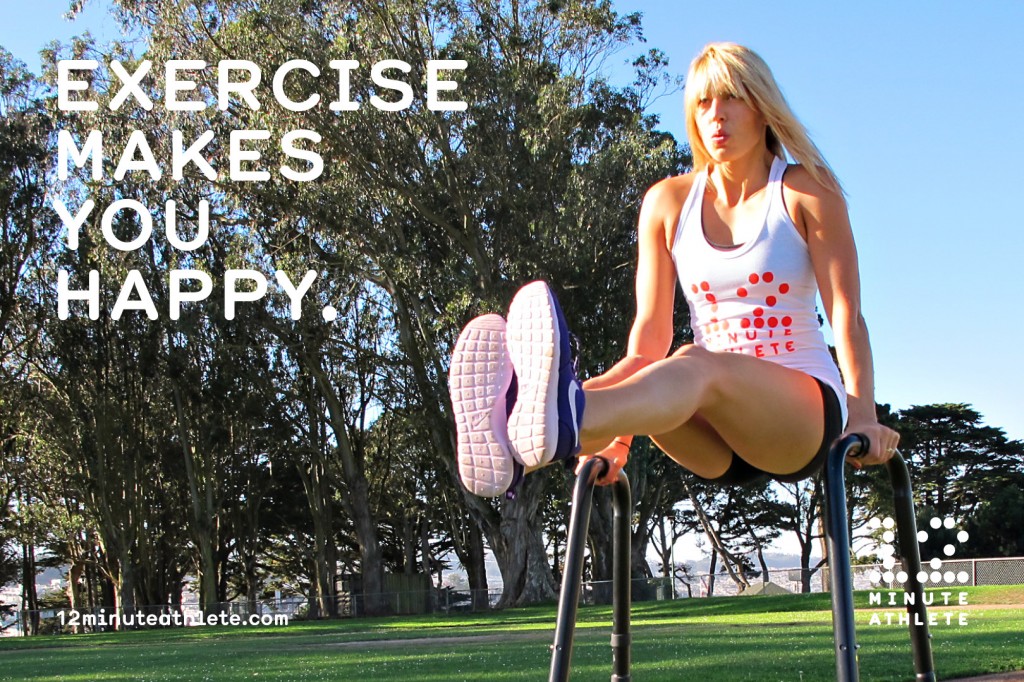
Is there a Link Between Exercise and Happiness?


If you've ever been stressed out, you may have attempted to relieve your anxiety in a number of ways: eating, logging hours in front of the television, or increasing your use of tobacco, alcohol or drugs (both legal and illegal). All of these represent attempts to take your mind off your worries, or in some instinctual way to alter your brain chemistry a bit. And sometimes it works.

However, many of our go-to strategies -- like gorging on chocolate ice cream or having an extra glass or two of wine -- also have negative consequences, especially when carried out repeatedly. In the long run, some behaviors undertaken to increase happiness can actually decrease it.

There is another strategy for reducing stress and improving mood that not only seems to make people happier, but also yields positive long-term effects more conducive to long-term happiness: exercise.

When we walk, run, bike or engage in some other form of physical exercise, we generally seem to feel happier and less anxious. People who are in poor physical condition are certainly no strangers to happiness, and one study of Stanford University student-athletes found that happiness for this group was more a result of their personality and temperament than it was of athletic prowess [source: Denny]. However, there are certainly aspects of physical fitness that grease the skids of happiness.

In addition to increased energy, physically active people may feel a sense of accomplishment in meeting personal fitness goals. Also, they may feel proud of the improved physical appearance that those hours in the gym have produced. And getting outdoors on a nice day -- or even working out indoors around a bevy of strangers -- stimulates the mind and shakes up what may be for some people an otherwise monotonous and cubicle-centric daily existence.

But is there a direct link between exercise and happiness? We know that exercise has been shown to improve the sleep patterns of insomniacs, as well as lower their anxiety [source: American Academy of Sleep Medicine]. Studies on rats indicate that exercise mimics the effects of antidepressants on the brain.


Exercise is also responsible for the creation of new brain cells in the part of the brain responsible for learning and memory [source: Karolinska Institutet]. Interestingly, happiness and exercise are similar in two notable ways: both are independently associated with a boost to the immune system, and also with the release of endorphins (the so-called "runners-high" and pain suppressant).

Saturday, April 4, 2015

The Bodyweight Workout - No Exercise Equipment Required


Personal trainer Stephen Cabral takes Sarah, host from diethealth.com, through a total body workout that uses just her body weight.

Invest in Yourself – 7 Steps to Optimal Health


Too often, I hear my friends talking about how they plan to start living healthier after the first of the year. But now, as we approach mid-May, many have put off their healthy-living goals to the point where they may be setting themselves up for failure: a 2009 study from the University of Hertfordshire in the United Kingdom found that more than 75 percent of New Year's resolution followers gave up. So who had the success stories? The people who broke down their goals into small, achievable steps.

Your life isn't an experiment or a fantasy. It's an investment in your future. You've heard it a million times: If you fuel yourself with junk and bad habits, you won't have the reserves to draw on for energy and good health. Consider each day an opportunity to invest in good habits, so you'll have stamina and great health to withdraw. You can't lose. Who wants to sit at home while the rest of the gang goes out to play?

And it's not just all about you. Do you want to be the parent or grandparent who sits on the sidelines, or the one who creates lasting memories for your kids or grandchildren by riding a bicycle right alongside them? Today, you can make your move so the dream of a long, active life becomes a reality.

But don't worry; you don't have to do it alone and you can get started any time of the year. I'm here to show you seven ways to push the reset button on your healthy habits - starting now. Even if you're already on a healthy track, there's always room for improvement.

1. Sleep It Off.
Recharge your sluggish metabolism. A 2009 study from the University of Chicago found that people who don't get a full night's sleep are more likely to gain weight and have more difficulty losing body fat when they are dieting.

Sleep experts say the most effective way to improve your sleep is to stick to a regular bedtime and regular wake-up time, even on the weekends. Ideally, your bedroom should be dark, cool and quiet. And move distracting, light-generating electronics like computers and TV sets out of your sleeping zone.

2. Drink Smarter. Ditch the conventional wisdom that your daily fluid intake should only consist of water. Drink juice, green tea or coffee if you want to, but be mindful of the calories. A fizzy Vitamin-C powder added to water may satisfy a soda urge. And branch out - I'm a huge fan of freshly-juiced green drinks made from spinach and kale. Note: You are not allowed to knock it until you try it.

3. Lose the Hidden Pounds. We can't underestimate the importance of elimination. To keep your colon healthy, increase your fiber intake to 25 grams a day. I'm also a fan of probiotics for regularity and increased vitality. And downing a fiber drink (yes, those) can actually help your body break down the fat in fat cells.

4. Make It A 5-Veggie Day. EVERY day. And get creative with it. If the kale juice seems unappealing, steam them and add a splash of olive oil to a batch (or some collard greens), and you'll quickly change your tune. The darkest, leafy greens help keep your bones strong, so don't skimp.

5. Shrug Off Sugar. Every time I cut back on refined sugars, my energy level rises and stays there. It's easy to fall into the trap of grabbing a sugary snack for a quick boost, but the crash that follows is never fun. Simple substitutions like choosing a piece of fruit over a glass of juice or sparkling water over soda can do wonders for your mood, energy levels, and waistline: A study of more than 50,000 nurses found that women who had just one sugary soda or glass of juice a day weighed more than those who drank less than one a month.

6. Grab Different Grains. So many people have gluten sensitivities that wreak havoc on their digestive systems. Not every food that contains the word "wheat" is a great choice for everyone. Choose purer grain choices like steel-cut oat meal, quinoa and brown rice. And don't be afraid to mix it up a bit, instead of using bread for sandwiches, wrap your lunch up in large lettuce leaves. You'll love the crisp, fresh flavor.

7. Shake It Up. I rarely travel without a blender, because protein shakes are a cornerstone of my daily diet. I like the Hamilton Beech single serving blender that has a convenient travel lid, then I add a protein powder that's low in sugar and mix it with frozen berries, soy, low-fat, or almond milk, some flaxseed oil, and swap it out for at least one meal a day. Another option is to seek out a great local juice bar for your shakes, either way it's a delightful breakfast, post-workout snack, or sweet-tooth-satisfier.

Friday, April 3, 2015

Prenatal Pilates for Each Trimester (Pilates for Pregnancy)


Lauren Small, of the American Fitness Network, performs several standard Pilates exercises and gives modifications for each trimester. As a Pilates instructor who is in her second trimester, Lauren shows how to make Pilates safe and effective. If you were not working out or performing Pilates exercises regularly before your pregnancy, talk to your doctor first. Many doctors advise waiting until after the first trimester before incorporating Pilates into a prenatal fitness program.

Monday, March 30, 2015

Why Physical Fitness is Important

We all know that being physically fit is good for us, but exactly why is physical fitness important? Here are the top 10 benefits of physical fitness:

1. You're more likely to live a long and healthy life. Regular exercise reduces the risk of developing heart disease, high blood pressure, high cholesterol, diabetes and several types of cancer. It also reduces the risk of having a stroke. In one eight year study of more than 20,000 men, those who were lean but unfit had twice the risk of death as those who were lean and fit.

2. You'll control your weight. If you try and lose weight simply by dieting, you'll lose primarily water (which is easy to gain back), some muscle, and a little bit of fat. If regular exercise is part of your weight loss program, you'll lose primarily fat and be able to maintain (or even gain) lean muscle mass. Most people who lose weight end up gaining it back because they don't exercise.

3. You'll have more energy, strength and stamina. People who complain that they don't have enough energy to exercise fail to realize that working out gives you energy. In one study, middle-aged women who lifted weights for a year became 27% more active in daily life than before they started lifting weights. Regular exercise also increases your strength and stamina, allowing you to better handle common activities such as carrying a heavy bag of groceries or climbing a flight of stairs.

4. You'll keep your bones strong. Both men and women start losing bone mass around age 35. Lifting weights can not only halt the decline, but in some cases can reverse it. This drastically reduces your risk of osteoporosis. Weight bearing exercises like walking and running also help keep your bones strong.

5. You'll keep your mind sharp. Multiple studies have confirmed that regular exercise is one of the best things you can do for your mind. It improves brain function, which helps prevent dementia and Alzheimer's disease.

6. You'll prevent or reduce low back pain. Strengthening your abdominal and lower back muscles can help prevent low back pain. It can also reduce discomfort if you already suffer from this pain. Also, you might be able to avoid back surgery by strengthening your abdominal and lower back muscles. In one study, 35 of 38 people who had been recommended for back surgery were able to avoid surgery by following an aggressive strengthening program.

7. You'll get sick less often. Regular exercise strengthens your immune system.

8. You'll improve your mood. A large amount of research shows that you have a better sense of well-being following a workout. Thanks to chemicals released in the brain during exercise, feelings of anxiety, depression, anger and stress are diminished during a workout.

9. You'll sleep better. People who exercise regularly fall asleep faster, sleep longer, and wake up less often during the night than people who are sedentary.

10. You'll enjoy life more. Life is much more enjoyable when you're fit and healthy. You have more energy, strength and confidence, and you're more productive in everything you do.

Why is physical fitness important? The bottom line answer is that many of the problems commonly associated with aging, such as disease, increased body fat, and loss of bone mass, energy and strength, are often the result of a sedentary lifestyle and can be minimized or prevented by improving your physical fitness.

Sunday, March 29, 2015

How to Build an Easy, Affordable Home Gym

Many people find it more comfortable, convenient, and affordable to log their exercise time in the privacy of their own house. You certainly don't need a gym filled with fancy equipment and trainers to get in great shape and shed unwanted pounds. For example, I believe that nothing beats a brisk walk outdoors around your neighborhood. Exercising indoors at home is also quite easy, with all the heart-pumping workout DVDs and affordable fitness equipment out there. Simply pick a space in your home and designate it as your at-home gym, then begin to gather a few essentials. With everything you need to get moving right there at your fingertips, you'll never have an excuse to skip a workout.Curious  about how to set up your own home gym? Here are some wallet-friendly basics to consider including

Yoga or exercise mat.
When doing floor exercises, exercise mats provide extra cushion for safer and more comfortable exercise. Use your yoga mat when doing ab work, stretching, floor exercises and Pilates.

3 to 5 pound weights and resistance bands.
Lifting weights is important to building a strong, fit body - it helps you tone your limbs and build muslce, and it's great for your bones and metabolism. If you're new to strength training, start with 2 to 3 pound dumbbells, and slowly work your way up to heavier weights as you develop muscle. Resistance bands are another strength training tool that are a great portable option for using at home and while you travel.

Balance and stability ball.
When you have a stability ball, you have dozens of exercises at your fingertips. This one ball can give you a full-body workout. It's an especially great tool for strengthening your core during sit-ups - or, you can actually sit on it instead of a chair. You'll automatically tighten and tone your midsection, just by sitting there.

Exercise DVDs.
I love fitness DVDs. Not only do they bring a trained instructor right into your home to show you exactly how to do the moves properly (and keep you motivated), but they allow you to mix up your workouts and keep your routine from getting stale. There are so many fun workouts to get your heart pumping. Try Kickboxing, Zumba, Pilates, dance workouts and boot camp DVDs - the list goes on and on!

Beginner yoga and stretching DVDs.
Many people don't consider stretching a workout - but it's actually a very important part of fitness. The more flexible you are, the less likely you are to be injured - and you know what recovery time from an injury can do to your waistline. Have a yoga or stretching DVD on hand to warm up your muscles before a workout and cool them down when you finish. As a bonus, you'll soothe away stress and feel much more limber.

A mirror to check your form.

I can't stress how important proper form is to an effective workout - the wrong form, or using equipment incorrectly, can cause pain and injury - and at the very least, your routine will lose some of it's effectiveness. Without an instructor or trainer around, it's up to you to ensure you are doing every move the right way. Do all exercises in front of a mirror so you can watch your posture and alignment, and make any corrections necessary to keep your body safe from injury.